
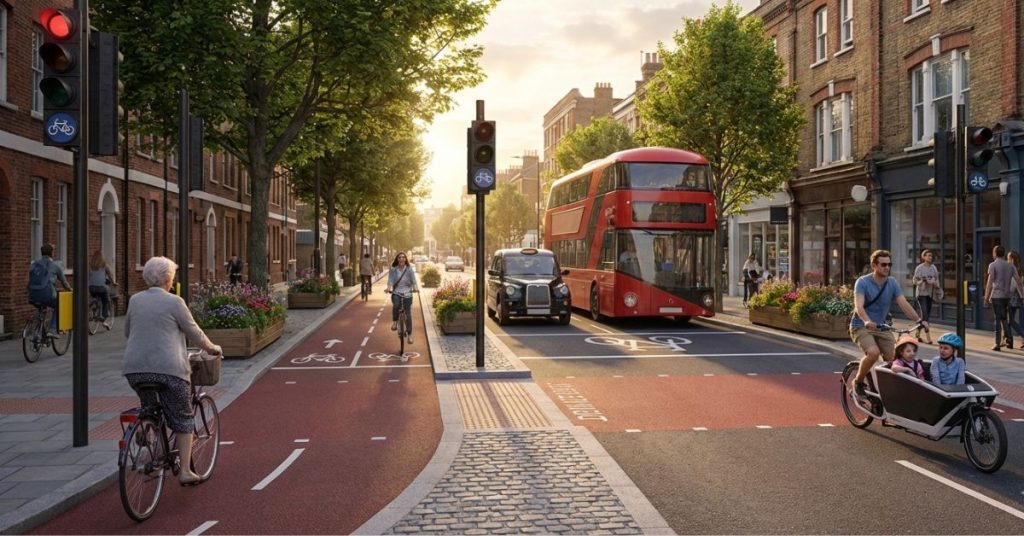
London loves to talk about cycling. From new bike lanes and Low Traffic Neighbourhoods to ambitious climate targets, cycling is always somewhere in the conversation. Yet for many Londoners, getting on a bike still feels stressful, risky, or simply inconvenient. Contrast that with Amsterdam, where cycling isn’t a lifestyle choice or a political statement it’s just how people get around. So what exactly makes Amsterdam’s cycling network work so well? And more importantly, what lessons can London realistically take from it? The answer isn’t just “build more bike lanes.” It’s about culture, consistency, and putting everyday people at the centre of street design.
Cycling as Normal Life, Not a Special Activity
One of the biggest differences between London and Amsterdam is how cycling is perceived. In Amsterdam, cycling is completely ordinary. You see parents riding with children, people cycling to work in normal clothes, older adults on upright bikes, and shoppers carrying groceries all without helmets, high-vis jackets, or expensive gear. In London, cycling often feels like a performance. Riders are expected to be fast, confident, and hyper-alert. Many people assume you need special clothing, technical knowledge, or nerves of steel just to survive rush hour traffic. This perception alone stops thousands of potential cyclists from ever starting. Amsterdam shows that when streets are designed well, cycling doesn’t need to feel extreme. London can learn that if you make cycling calm and predictable, people of all ages and abilities will naturally take it up.
Proper Separation: Designing Streets That Feel Safe
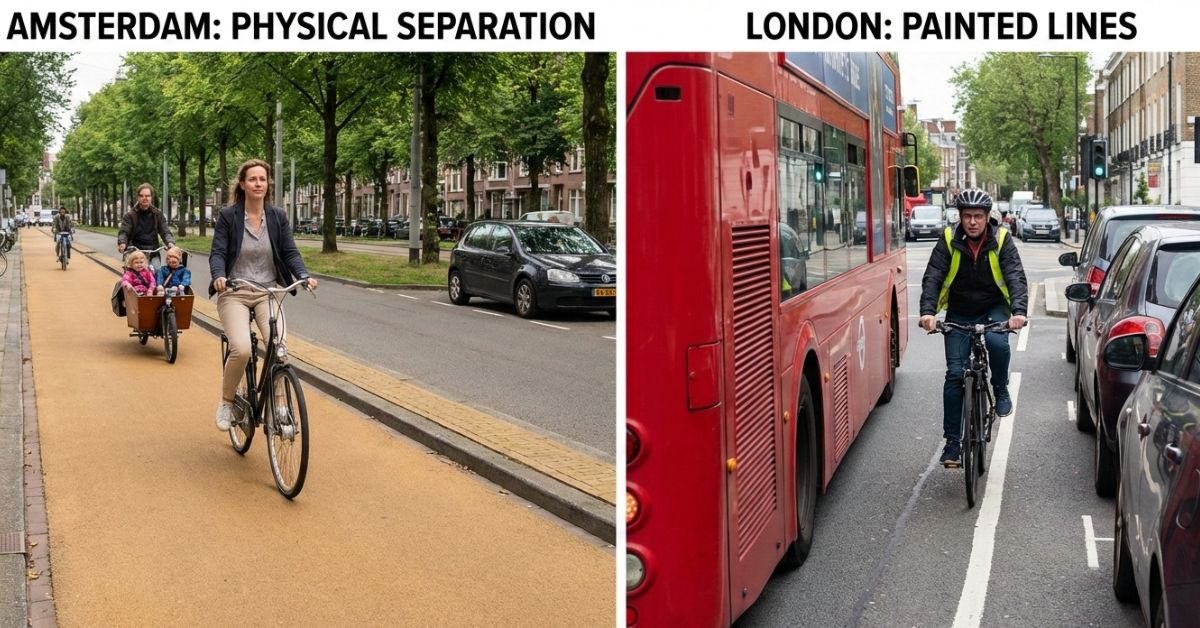
Amsterdam’s cycling network succeeds because it prioritises physical separation. Bike lanes are not just painted lines squeezed between cars and parked vehicles. They are clearly defined spaces, often raised or set apart from traffic, with their own flow and logic. In London, too many cycle lanes feel like an afterthought. They disappear at junctions, merge suddenly with traffic, or force cyclists into conflict with buses and lorries. Even confident riders find this stressful. Amsterdam treats safety as non-negotiable. Intersections are designed to reduce conflict, not test reflexes. Cyclists have clear priority, visibility is improved, and speeds are kept low where bikes and cars interact. London doesn’t need to copy Amsterdam street by street, but it does need to commit to consistency. A cycle lane that suddenly vanishes teaches people one thing: you’re on your own.
Junctions Matter More Than Long Bike Lanes
London has made progress on long cycling routes, especially into central areas. But many of the most dangerous moments for cyclists happen at junctions, not on straight roads. Amsterdam understands this and designs intersections specifically with cyclists in mind. Protected junctions, clear signalling, and simple layouts reduce confusion and crashes. Cyclists don’t have to guess whether a car will turn across them or accelerate suddenly. Everyone knows where they’re supposed to be. In London, junctions are often where even good cycling infrastructure falls apart. Painted lanes vanish, priorities become unclear, and riders are forced into stressful decisions. Learning from Amsterdam means focusing less on headline-grabbing routes and more on the everyday junctions people use to get to shops, schools, and workplaces.
Speed Control Changes Everything
Another lesson London can learn is the importance of speed. Amsterdam doesn’t rely on signs alone to slow cars down. The streets themselves are designed to make high speeds uncomfortable or unnecessary. Narrower lanes, raised crossings, tight corners, and shared spaces all encourage drivers to slow naturally. When cars move slower, cycling feels safer even without heavy infrastructure. London often takes the opposite approach: wide roads, long straight stretches, and then signs asking drivers to slow down. It rarely works. Design influences behaviour far more than rules. Amsterdam proves that when streets are built for people first, everyone adapts.
Cycling for All Ages and Abilities
One of the most striking things about cycling in Amsterdam is who you see on bikes. Children ride to school independently. Older adults cycle well into later life. People with disabilities use adapted cycles. Cargo bikes replace cars for many family trips. This didn’t happen by accident. Amsterdam built a network that supports slow cycling, not just fast commuting. Paths are wide, surfaces are smooth, and routes avoid unnecessary stress. London’s cycling culture often caters to the confident and the fit. If cycling is to grow beyond a niche, infrastructure needs to work just as well for someone riding at a gentle pace with shopping bags as it does for a commuter racing the clock.
Consistency Builds Trust
Amsterdam’s cycling network didn’t appear overnight. It was built gradually, but with a clear long-term vision. People trust it because it’s reliable. A cycle lane today will still be there tomorrow. Routes connect logically instead of stopping abruptly at borough boundaries. London struggles with fragmentation. Cycling conditions can change dramatically from one street to the next, or from one borough to another. This inconsistency creates uncertainty, which discourages new riders. Learning from Amsterdam means committing to long-term planning beyond political cycles. Cycling infrastructure only works when people believe it’s permanent.
Local Streets Are Just as Important as Main Routes
Amsterdam’s success isn’t just about big cycling corridors. Quiet residential streets are designed to prioritise people walking and cycling, with cars treated as guests rather than owners of the road. London has made some progress here through Low Traffic Neighbourhoods, but the approach is uneven and often controversial. Amsterdam shows that when these changes are done well and supported properly, they become widely accepted over time. People don’t just cycle along main roads they start and end their journeys on local streets. Making those streets calm, safe, and pleasant is essential.

Culture Follows Infrastructure, Not the Other Way Around
A common argument in London is that “cycling culture” needs to change first. Amsterdam proves the opposite. People didn’t become confident cyclists and then demand better infrastructure the infrastructure came first, and behaviour followed. When streets feel safe, people cycle calmly. When cycling feels normal, conflict reduces. When more people cycle, drivers become more aware and respectful. London doesn’t need to wait for a cultural shift. It needs to build conditions that allow that shift to happen naturally.
What This Means for London’s Cycling Future
London will never be Amsterdam, and it shouldn’t try to be. The cities are different in history, density, and layout. But the principles that make Amsterdam’s cycling network successful are transferable. Safety over speed. Consistency over shortcuts. People over vehicles. If London embraces these lessons fully not just in isolated projects but as a citywide philosophy cycling could become something ordinary rather than intimidating. For communities, local businesses, and everyday riders pushing for better cycling conditions, the inspiration is clear. Whether it’s grassroots campaigns, borough-level improvements, or local initiatives like Southwarkcycles, the path forward isn’t about copying a city it’s about committing to streets that work for everyone.