
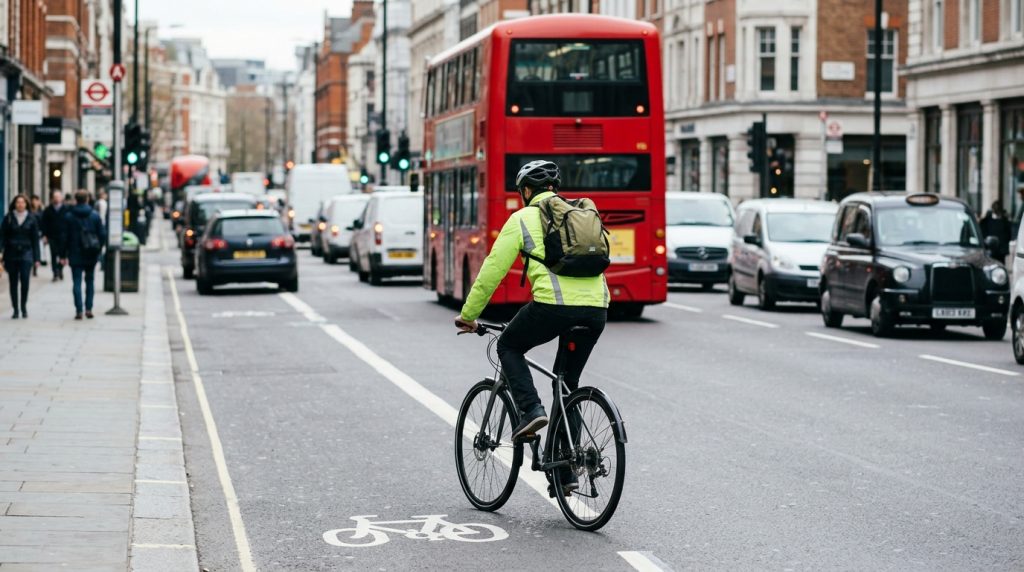
Cycling around London can be a convenient, affordable and enjoyable way to get around, but busy roads can sometimes feel intimidating. Buses, taxis, vans, cars and other cyclists all share limited road space, while frequent junctions, bus stops and changing traffic conditions require you to stay alert.
One of the most important things to understand is that riding safely around heavy traffic is not about cycling as quickly as possible. It is about being predictable, positioning yourself correctly, anticipating what other road users might do and knowing when to slow down or wait.
Buses and other large vehicles deserve particular attention because their size creates significant blind spots. A driver may not always be able to see a cyclist, even when the cyclist believes they are clearly visible.
Here are some practical ways to stay safer when cycling around buses and heavy traffic.
1. Keep Your Distance From Large Vehicles
One of the simplest ways to improve your safety is to avoid riding too close to buses, coaches, HGVs and other large vehicles.
Large vehicles have areas around them where the driver may have limited or no visibility. This is particularly important when approaching junctions, bus stops and traffic lights.
If you find yourself riding alongside a bus for an extended period, consider whether you really need to remain there. If the bus starts moving, slowing down or indicating, it may be safer to reduce your speed and allow it to move ahead.
TfL advises cyclists to take particular care around large vehicles and avoid waiting or cycling in their blind spots. If a large vehicle pulls alongside you, using your brakes to drop behind it can be safer than trying to remain beside it.
Remember: if you cannot see the driver’s mirrors, there is a good chance the driver may not be able to see you either.
2. Never Try to Squeeze Between a Bus and the Kerb
This is one of the most important rules to remember when cycling around buses.
A bus may appear to leave enough space between itself and the kerb, but that space can disappear very quickly. The bus may move towards the kerb, pull into a bus stop or turn left.
The Highway Code specifically advises cyclists not to pass between the kerb and a bus when it is at a bus stop.
Instead of trying to squeeze through, slow down and wait behind the bus if necessary.
Arriving at your destination a few seconds later is far better than taking an unnecessary risk.
3. Be Careful When Approaching Bus Stops
Bus stops are particularly unpredictable areas for cyclists.
A bus may pull in to pick up passengers, move away from the kerb or suddenly stop because someone is waiting. At the same time, passengers may step into the road or cross towards the pavement.
When approaching a bus stop, reduce your speed and look for:
- People waiting near the kerb
- Passengers getting off the bus
- People crossing towards the pavement
- A bus indicating to pull away
- Other cyclists attempting to pass
- Traffic approaching from behind
If a bus is already stopped, consider waiting behind it rather than attempting to pass if there is insufficient space.
The Highway Code also advises cyclists to watch for people getting on or off buses and to take particular care when leaving a bus lane because they may be entering a busier traffic flow.
4. Stay Out of Blind Spots
Blind spots are one of the biggest dangers when cycling around buses and heavy vehicles.
A cyclist can sometimes be physically close to a vehicle while remaining invisible to the driver. This becomes particularly dangerous when the vehicle is preparing to turn.
Avoid riding alongside a large vehicle at junctions whenever possible. If a bus or lorry is indicating, do not assume that you have been seen.
Instead, slow down and give the vehicle enough space to complete its manoeuvre.
TfL recommends making eye contact with drivers where possible, but it also warns cyclists not to assume they have been seen simply because they have looked towards the driver.
5. Be Especially Careful at Junctions
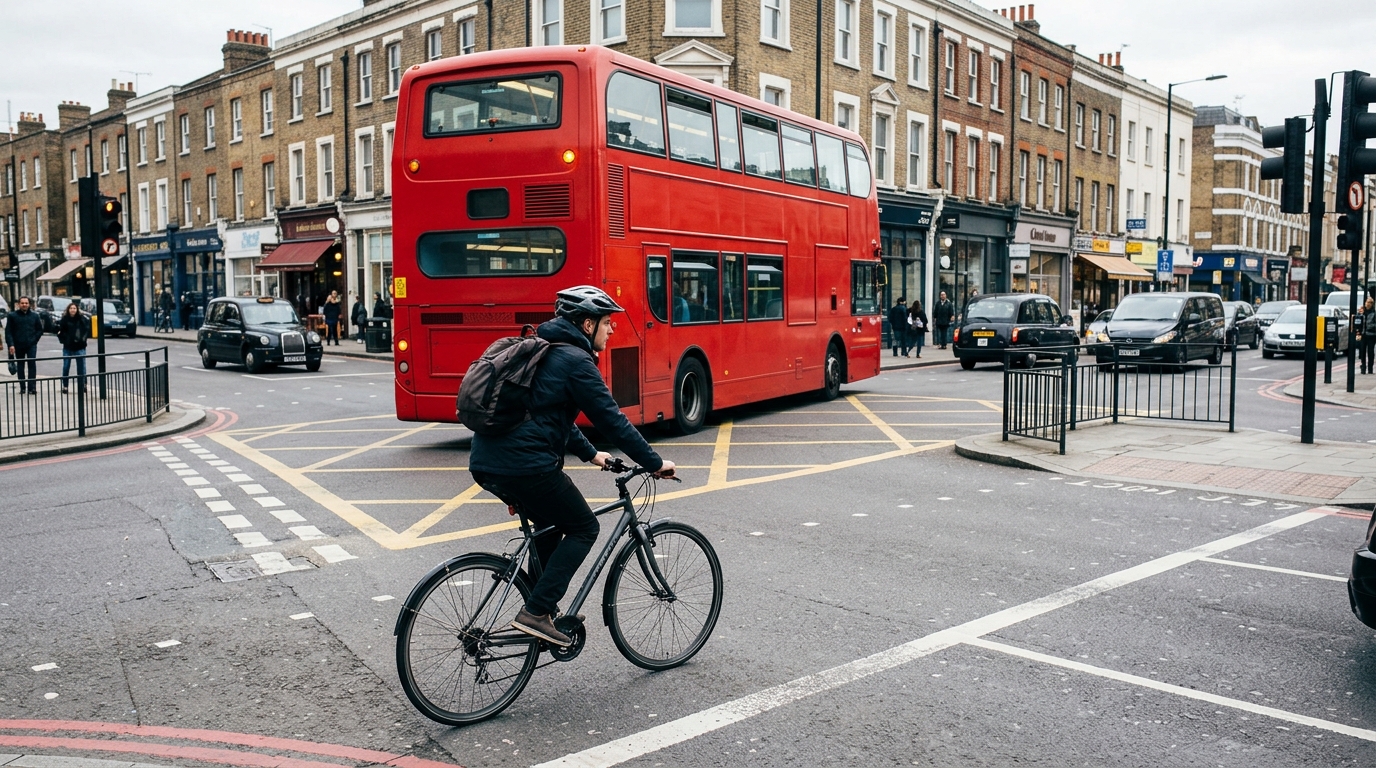
Junctions are some of the most complicated areas of London’s roads because several different movements can happen at once.
A bus might be turning while you are travelling straight ahead. A car might be waiting to turn across your path. A pedestrian could be preparing to cross. Another cyclist may also be approaching from behind.
Slow down as you approach busy junctions and think about what each road user might do next.
If you are going straight ahead, keep checking the traffic around you rather than concentrating only on the vehicle immediately in front.
The Highway Code says cyclists should take particular care when passing stationary or slow-moving traffic near junctions because drivers may not see them.
6. Don’t Undertake a Bus or Lorry at a Junction
Passing on the left can seem tempting when traffic is stationary, but it can become extremely dangerous near junctions.
A bus or lorry may suddenly turn left while you are alongside it. Because of the vehicle’s size and blind spots, the driver may not know that you are there.
If a large vehicle is indicating or preparing to turn, the safest choice may be to slow down and remain behind it.
The Highway Code specifically warns cyclists to take great care when passing large vehicles near junctions and says not to ride on the inside of vehicles that are signalling or slowing to turn left.
7. Make Your Road Position Clear
Your position on the road can make a big difference to how other road users interact with you.
Avoid riding extremely close to the kerb when doing so would leave you with no room to avoid potholes, drains, parked vehicles or other hazards.
You also need to leave enough space from parked cars to avoid suddenly opening doors.
The Highway Code recommends leaving enough room — around a door’s width or 1 metre — when passing parked vehicles.
Good road positioning also helps make your movements more predictable. Drivers are more likely to understand where you are going when you maintain a steady line instead of constantly moving between the kerb and traffic.
8. Check Behind You Before Changing Position
Busy London roads require constant awareness of what is happening behind you.
Before moving out to avoid an obstruction, overtake, change lanes or prepare for a turn, check behind you and make your intentions clear.
A quick shoulder check followed by a clear signal can help other road users understand what you intend to do.
Do not make sudden movements simply because you have spotted a pothole or parked vehicle at the last moment. If possible, plan ahead and check the road surface early.
The Highway Code advises cyclists to look around before moving away from the kerb, overtaking, passing stationary vehicles, turning or stopping.
9. Don’t Follow Too Closely Behind Buses
It can be tempting to sit directly behind a bus because it provides some protection from other traffic.
However, following too closely means you cannot see what is happening ahead.
A bus can stop suddenly, pull into a bus stop or change direction. You may also be unable to see pedestrians, roadworks, potholes or traffic lights until the last moment.
Leave enough space to react if the bus slows down suddenly.
The Highway Code advises cyclists not to ride close behind another vehicle because it may stop suddenly.
10. Use Cycle Lanes Where They Make Your Journey Safer
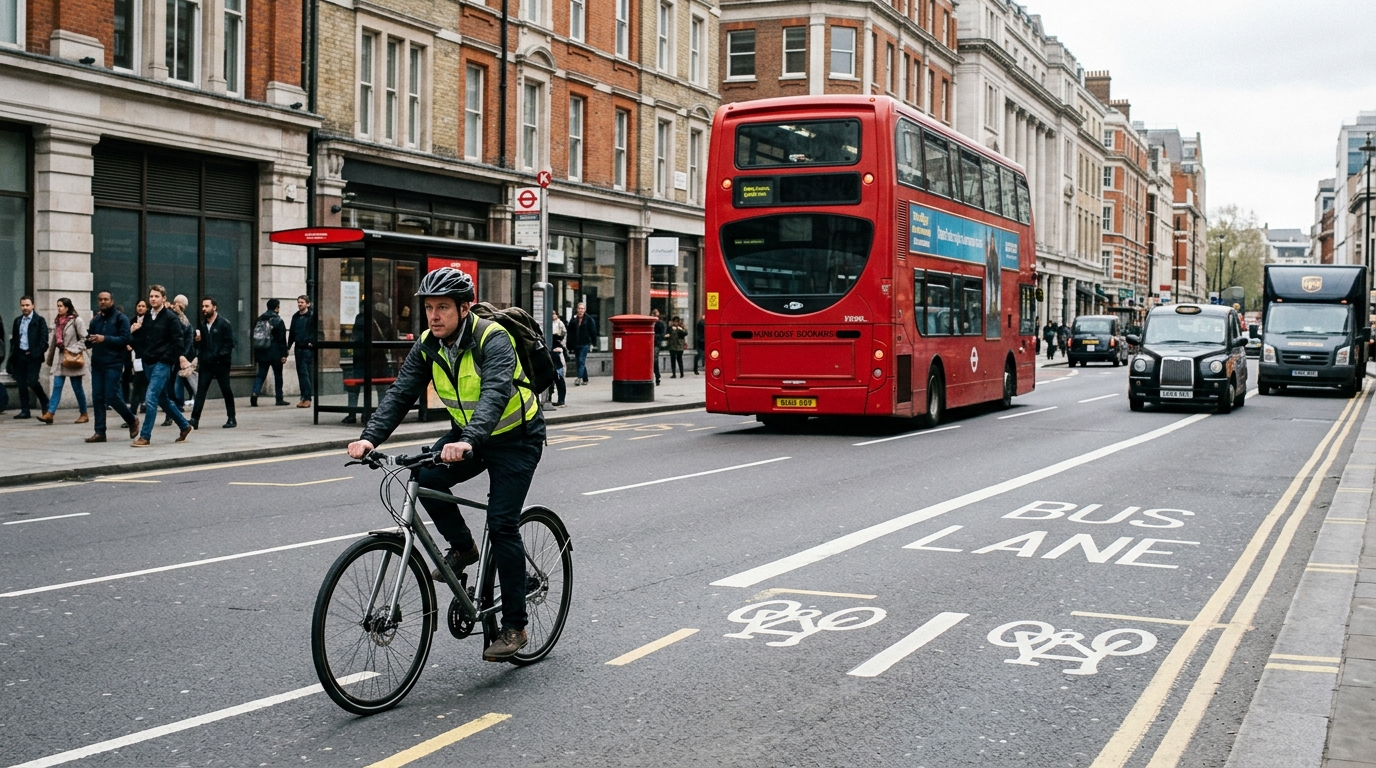
Cycle lanes and tracks can provide useful separation from motor traffic, particularly on busy roads.
However, you still need to remain alert. A cycle lane may cross junctions, bus stops or driveways where other road users can enter your path.
The Highway Code says cyclists should use cycle facilities where they make the journey safer and easier, depending on the situation, experience and conditions.
Pay particular attention where a cycle lane runs alongside a bus stop. Passengers may step across the cycle lane without noticing an approaching cyclist.
Slow down and be prepared to stop.
11. Make Yourself Easy to See
Visibility becomes particularly important during early mornings, evenings, poor weather and darker winter months.
Keep your bicycle’s lights clean and working correctly. In the UK, a bicycle must have a white front light and red rear light when ridden at night.
Bright or reflective clothing can also help other road users notice you.
However, being visible does not mean you can assume everyone has seen you. Continue checking the behaviour of surrounding traffic and be prepared to slow down.
12. Stay Calm When Traffic Gets Busy
Heavy traffic can make cycling stressful, particularly if vehicles are moving closely around you.
Try not to respond to pressure by rushing.
If a driver is waiting behind you, do not allow that pressure to make you take a manoeuvre that does not feel safe. Wait for an appropriate opportunity to change position or allow the vehicle to pass where it is safe.
Likewise, if traffic suddenly becomes complicated, slowing down can give you more time to assess what is happening.
A calm cyclist who anticipates hazards is generally in a much better position than someone who reacts at the last second.
13. Be Extra Careful in Bad Weather
Rain, strong winds and poor visibility can make busy roads more difficult to navigate.
Wet surfaces can reduce grip, while rain can make it harder for drivers and cyclists to see each other clearly. Puddles can also hide potholes and other road defects.
Give yourself more time, reduce your speed when necessary and leave additional space around buses and other vehicles.
The Highway Code recommends taking extra care and allowing more space around vulnerable road users in poor weather and at night.
14. Keep Your Bicycle in Good Condition
Safe riding starts before you even reach the road.
Check your brakes, tyres, wheels, chain, gears and lights regularly. Your brakes need to work effectively, while tyres should be in good condition and inflated according to the pressure shown on the tyre.
A bicycle that is poorly maintained can make an already challenging traffic situation much harder to handle.
The Highway Code recommends checking key components including tyres, wheels, gears, chain, saddle, handlebars, lights and brakes.
15. Plan Your Route Before You Ride
If you are nervous about heavy traffic, route planning can make a significant difference.
You may be able to choose roads with quieter traffic, dedicated cycle infrastructure or fewer complicated junctions.
Knowing where the difficult sections are before you start also means you can prepare yourself rather than being surprised by a busy junction or complicated road layout.
If you are new to cycling in London, consider practising on quieter roads first and gradually building your confidence on busier routes.
Cycle training can also help riders develop skills such as road positioning, signalling, route planning and handling complex junctions.
Final Thoughts
Cycling around buses and heavy traffic does not have to be intimidating, but it does require awareness and good judgement. Give large vehicles plenty of space, avoid blind spots, never squeeze between a bus and the kerb, take extra care around bus stops and junctions, and be prepared to slow down when the situation becomes complicated.
Most importantly, remember that arriving safely matters more than arriving quickly. With good road positioning, proper signalling, a well-maintained bicycle and an understanding of how buses and other large vehicles behave, you can become much more confident when cycling on London’s busy roads.
For cyclists looking for a reliable bike, accessories, maintenance or servicing support for everyday London riding, Southwark Cycles can help you choose and maintain a bicycle that suits your needs and your daily journeys.


